Key Takeaways
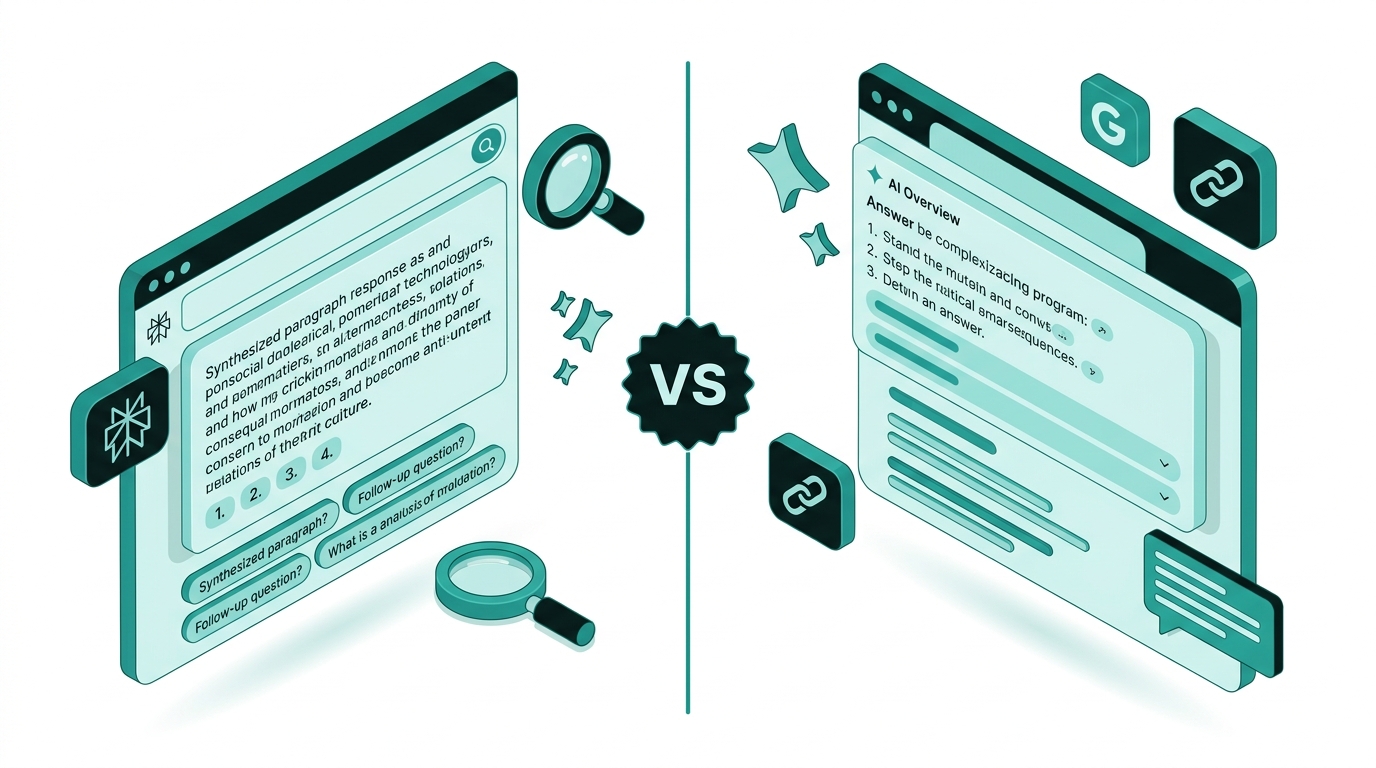
- Perplexity AI is a standalone answer engine that synthesizes information from multiple sources and embeds citations directly inside each response, while Google AI Overviews are an add-on layer within traditional Google Search results.
- Perplexity Pro costs $20 per month (or $200 per year) and unlocks access to premium models like GPT-4o and Claude 3.7 Sonnet; Google AI Overviews are completely free and ad-supported.
- Independent testing found Perplexity’s error rate on specialized topics sits around 13%, roughly half of Google AI Overviews’ 26% error rate on topics like PPC advertising costs.
- Google AI Overviews now appear on approximately 55-60% of all Google searches globally, after expanding to over 200 countries and 40+ languages in 2025.
- Perplexity supports multi-turn conversational follow-up with persistent context, while Google AI Overviews link to AI Mode for deeper conversational capabilities using Gemini 2.0.
- Perplexity’s free tier allows up to 5 Pro (deep) searches per day with unlimited standard searches; Google AI Overviews have no usage cap since they are embedded in regular Google Search.
- Google AI Overviews integrate tightly with Maps, local listings, calendars, and Shopping, making them superior for location-based and commercial queries; Perplexity is stronger for research, academic, and technical topics that require traceable sourcing.
The way people look for information online is changing fast. Two tools are at the center of that shift: Perplexity AI and Google AI Overviews. Both use large language models to generate direct, synthesized answers instead of simply returning a list of links. But they take very different approaches to how those answers are built, cited, and delivered.
Google AI Overviews appear automatically at the top of many search results pages, layering AI-generated summaries over the same search infrastructure billions of people already use every day. Perplexity, by contrast, is a purpose-built AI answer engine that replaces the search results page entirely, giving you a single, cited, conversational response to any query. Choosing between them depends a lot on what you are trying to accomplish and how deeply you need to verify the information you get back.
This guide breaks down both tools across every dimension that matters: accuracy, source citations, conversational depth, real-time data access, pricing, and the specific situations where each one pulls ahead. Whether you are a student doing research, a professional verifying industry data, or someone who just wants a fast answer to a quick question, the right tool is not always the same one.
Quick Comparison: Perplexity vs Google AI Overviews
| Feature | Perplexity AI | Google AI Overviews |
|---|---|---|
| Type | Standalone AI answer engine | Add-on layer inside Google Search |
| Free tier | Yes (unlimited standard searches, 5 Pro/day) | Yes (no usage cap) |
| Paid plan | $20/month (Pro), $200/year | No paid tier (ad-supported) |
| Inline citations | Yes, embedded per sentence | Partial (listed at bottom of overview) |
| Conversational follow-up | Yes, persistent context | Limited (links to AI Mode) |
| Real-time web access | Yes | Yes |
| Model choice | GPT-4o, Claude 3.7, Sonar, and others (Pro) | Gemini 2.0 (fixed) |
| Ads in results | No | Yes (ads integrated into AI Overviews) |
| Local/maps integration | Limited | Strong (Maps, local listings) |
| Image/multimodal input | Yes (Pro) | Yes (AI Mode) |
| Error rate (specialized topics) | ~13% | ~26% |
| Best for | Research, citations, technical queries | Quick answers, local queries, shopping |
What is Perplexity AI?
Perplexity AI launched in 2022 as an answer engine built around a simple idea: instead of handing you ten blue links, give you one direct, cited answer synthesized from across the web. The product has grown rapidly, reaching 780 million monthly queries in 2025, up from 230 million the previous year, and it has attracted backing from major investors including Jeff Bezos and NVIDIA.
At its core, Perplexity combines a retrieval system that fetches fresh web content with a large language model that synthesizes that content into a coherent response. Every claim in the answer is tied back to a numbered source, which you can click to verify. This is the defining characteristic that separates Perplexity from most other AI tools: transparency at the sentence level, not just a vague list of sources at the bottom of the page.
The free tier gives you unlimited standard searches and up to 5 Pro searches per day. Pro searches use more powerful models and perform more thorough multi-step web retrieval. Upgrading to Perplexity Pro ($20 per month, or $200 per year) removes that daily Pro limit and unlocks access to premium models including OpenAI’s GPT-4o, Anthropic’s Claude 3.7 Sonnet, and Perplexity’s own Sonar model. Pro subscribers also get $5 in monthly API credits, unlimited file uploads, and AI image generation.
Perplexity has no advertising. Every result is generated purely based on what the model retrieves from the web, with no sponsored placements influencing which sources appear or how they are ranked. For users who want unbiased research without commercial interference, this matters significantly.
What are Google AI Overviews?
Google AI Overviews began rolling out publicly in mid-2024 under the branding previously known as Search Generative Experience (SGE). By 2025, they had expanded to over 200 countries and 40+ languages, and they now appear at the top of approximately 55-60% of all Google searches globally. They are powered by a customized version of Gemini 2.0 and are completely free for anyone with a Google account.
When an AI Overview appears, it generates a short synthesized answer directly on the search results page before the organic blue links below. The answer draws from pages Google has already crawled and indexed, and a panel of source links appears at the side or bottom of the overview. In February 2026, Google updated this panel to show more prominent and richer source attribution.
One of Google AI Overviews’ biggest strengths is deep integration with the rest of Google’s ecosystem. A query about a local restaurant can pull in Maps data, reviews, and hours. A question about a product can trigger Shopping results. A sports score query links to live data. This integration makes AI Overviews feel seamless for people who already live inside Google’s products, which is most of the world’s internet users.
Google has also introduced AI Mode, a dedicated tab in Search that uses Gemini 2.0 to provide extended, multi-turn conversational responses on complex topics. AI Mode goes beyond what standard AI Overviews offer, supporting multimodal input and much longer threads. However, AI Mode is a separate experience from the AI Overviews that appear automatically in regular search.
Feature-by-Feature Breakdown
Answer Quality and Accuracy
Accuracy is the most important dimension for anyone making decisions based on AI-generated information, and the gap between Perplexity and Google AI Overviews here is meaningful. A study analyzing performance on PPC and digital advertising topics found Google AI Overviews produced errors in approximately 26% of responses, compared to roughly 13% for Perplexity. That 2x gap reflects a real structural difference in how each tool prioritizes information retrieval.
Perplexity performs a fresh web retrieval for each query, pulling multiple sources and synthesizing them in real time. The model is specifically tuned to reason across sources and flag uncertainty. Google AI Overviews draw heavily from Google’s existing index and are optimized for speed and broad coverage, which works well for general topics but can produce outdated or oversimplified answers for technical or niche subjects.
For everyday questions about general knowledge, both tools perform reasonably well. The accuracy gap becomes more pronounced for queries that require precise, up-to-date figures, regulatory details, pricing data, or nuanced comparisons across multiple sources. For that kind of research, Perplexity’s retrieval-first architecture gives it a genuine edge.
Source Citations
Perplexity’s citation system is one of its strongest differentiators. Every sentence or claim in a Perplexity answer is tagged with a numbered superscript that links directly to the source page. You do not have to guess which source supports which claim. You can click through and read the original paragraph yourself. This makes Perplexity unusually useful for anyone who needs to verify information before quoting or acting on it.
Google AI Overviews take a different approach. Sources appear as a panel alongside or below the overview, but they are not mapped to specific sentences or claims within the text. You can see that Google consulted several pages, but you cannot easily trace a specific fact back to a specific source. Google improved its source panel visibility in early 2026, adding richer previews and more prominent links, but the inline traceability that Perplexity offers is still not part of the experience.
For research purposes, Perplexity’s approach is far more rigorous. For casual queries where you just want a quick answer and are not concerned with verification, Google’s approach is perfectly adequate and arguably less distracting.
Follow-up Conversations
Perplexity was built as a conversational answer engine from day one, and multi-turn conversations feel natural within the product. When you ask a follow-up question, Perplexity retains the context from your previous turns, so you can narrow a topic, request a specific format, or push back on an answer and get a refined response that builds on what came before. This is particularly useful for iterative research where each answer raises new questions.
Standard Google AI Overviews are not conversational in the same way. The overview appears in response to a single query, and navigating to a new search resets the context. Google has addressed this through AI Mode, which does support multi-turn conversations with persistent context and is powered by Gemini 2.0. However, AI Mode requires users to actively choose that tab rather than appearing automatically, and it is still a newer experience that not all users have adopted.
For users who think in threads and like to explore a topic through iterative questions, Perplexity’s built-in conversational model is a clear advantage. Google AI Mode is catching up, but the workflow requires an extra step that Perplexity makes unnecessary.
Real-Time Information
Both Perplexity and Google AI Overviews have access to real-time web content, which puts them ahead of closed-model tools with fixed training cutoffs. However, the way each handles recency differs in practice.
Perplexity retrieves fresh content at the time of each query. If a news story broke an hour ago and has been indexed by web crawlers, Perplexity can surface it. The model also indicates when information may be time-sensitive, which helps users understand confidence levels.
Google AI Overviews draw from Google’s search index, which is among the most current in the world. For breaking news and real-time events, Google’s breadth of indexed content gives it a strong advantage. The Search integration means that for live sports scores, weather, stock prices, and similar dynamic data, Google remains the faster and more reliable source simply because it has been optimizing real-time data feeds for decades.
For general research and professional topics, both tools are similarly capable. For truly live or breaking content, Google’s index depth gives it a practical edge.
Pricing
Google AI Overviews have no cost to the user. They appear automatically within Google Search, which is free, and are supported by advertising revenue. In 2025, Google began serving ads inside AI Overviews on desktop, meaning sponsored content is integrated directly into the AI-generated answer. This is a meaningful distinction for users who want unbiased results.
Perplexity has a functional free tier that allows unlimited standard searches and up to 5 Pro searches per day. There are no ads in any tier. The Pro plan costs $20 per month or $200 per year (saving roughly $40 annually). Pro unlocks unlimited Pro searches, access to premium third-party models, file upload capabilities, and AI image generation. An Enterprise tier is available at $40 per seat per month for teams needing organizational controls and SSO. A Max plan at $200 per month is also available for power users needing the highest usage limits.
For individuals, the choice often comes down to whether you need verified, citation-level research. If you do, Perplexity Pro at $20 per month is competitive with other premium AI tools. If your needs are more casual and you do not mind ads in results, Google AI Overviews cost nothing.
Who Should Use Which?
Use Perplexity if you: need verifiable sources with inline citations, do research for academic, professional, or journalistic work, want to ask follow-up questions without losing context, prefer an ad-free experience, need to compare information across multiple niche or technical sources, or want to choose your AI model (GPT-4o, Claude, or Sonar).
Use Google AI Overviews if you: want quick answers embedded directly in your existing Google Search workflow, need local results tied to Maps or business listings, are searching for product information that benefits from Shopping integration, want completely free access with no subscription required, or are researching broad, general-knowledge topics where citation-level verification is not critical.
Use both if you: want the convenience of Google for everyday queries and the depth of Perplexity when you need to dig into a topic, verify a claim, or build a research brief. These tools are not mutually exclusive, and many power users treat them as complementary rather than competing alternatives. You might start a query in Google to get a fast overview and then move to Perplexity when you need traceable sourcing or want to follow a thread of questions through a complex topic.
Students writing papers will almost always benefit from Perplexity’s inline citations. Marketing professionals researching campaign benchmarks will appreciate Perplexity’s ability to pull from industry whitepapers and niche publications rather than only well-known domains. Developers exploring coding AI comparisons will find Perplexity’s technical accuracy and multi-model access especially useful.
Verdict
Perplexity AI and Google AI Overviews solve different problems, and declaring one the outright winner misses the point. That said, there are clear patterns in where each excels.
Perplexity is the better tool for research. Its inline citation model, lower error rate on specialized topics, conversational depth, and ad-free results make it purpose-built for anyone who needs to trust and verify the answers they get. The $20 per month Pro plan is competitive for the access it provides, and the free tier is genuinely useful for lighter research needs.
Google AI Overviews are the better tool for everyday use within the Google ecosystem. The seamless integration with Search, Maps, Shopping, and real-time data feeds makes them the default choice for most of the world’s internet users, and the free access with no signup required removes all friction. The accuracy gap and lack of inline citations are real limitations, but for quick, general-purpose queries, those limitations rarely matter.
If you do research, write reports, fact-check claims, or routinely need to know exactly where a piece of information came from, Perplexity is the stronger choice. If you want fast answers that slot into how you already use Google, AI Overviews will serve you well for most daily needs. The best approach for most people is to use both, each for what it does best. Explore more AI writing comparisons to find the right stack for your workflow.
Frequently Asked Questions
Is Perplexity better than Google for research?
For research that requires verified, traceable sources, Perplexity is generally the stronger tool. It embeds citations at the sentence level, has a roughly 13% error rate on specialized topics (compared to 26% for Google AI Overviews), and supports multi-turn conversations that let you dig deeper into a subject without losing context.
Are Google AI Overviews free?
Yes. Google AI Overviews appear automatically within standard Google Search at no cost. They are supported by advertising, and since 2025 Google has begun integrating ads directly inside AI Overview results on both mobile and desktop.
How much does Perplexity Pro cost?
Perplexity Pro costs $20 per month or $200 per year (roughly $16.67 per month billed annually). This unlocks unlimited Pro searches, access to premium models including GPT-4o and Claude 3.7 Sonnet, unlimited file uploads, and AI image generation. A free tier is also available with unlimited standard searches and up to 5 Pro searches per day.
Does Perplexity have ads?
No. Perplexity does not serve ads in any of its tiers. Results are generated purely from web retrieval without commercial influence on which sources appear. This is a significant contrast with Google AI Overviews, which integrate sponsored content into AI-generated answers.
Can Google AI Overviews have follow-up conversations?
Standard AI Overviews that appear automatically in search results do not support multi-turn conversations. Google’s AI Mode, available as a separate tab in Search and powered by Gemini 2.0, does support conversational follow-ups with persistent context. However, AI Mode requires users to navigate to it separately rather than appearing automatically.
Which tool is more accurate?
Perplexity has a lower error rate on specialized and technical topics based on available testing. Google AI Overviews perform well on broad, general-knowledge queries but have shown higher error rates on niche subjects like advertising metrics, regulatory details, and up-to-date pricing information.
Does Perplexity show sources for every answer?
Yes. Perplexity embeds numbered source citations directly into the body of each answer, linked at the sentence or claim level. You can click any citation to verify the specific source that supports a given fact. This is one of Perplexity’s defining features and a major reason it is preferred for research-intensive work.
What models does Perplexity use?
Free users access Perplexity’s own Sonar model. Pro subscribers can switch between multiple premium models including OpenAI’s GPT-4o, Anthropic’s Claude 3.7 Sonnet, and Perplexity’s advanced Sonar Pro model. This flexibility lets users choose the model that performs best for their specific type of query.
Which is better for local search?
Google AI Overviews win clearly for local search. They integrate with Google Maps, local business listings, reviews, and real-time business information in ways that Perplexity does not currently match. For questions like finding nearby restaurants, checking business hours, or comparing local service providers, Google remains the stronger tool.
Both Perplexity and Google AI Overviews represent a genuine shift in how AI is changing the way people find information. The old model of searching and clicking through ten results is giving way to synthesized, direct answers, though the quality, transparency, and trustworthiness of those answers varies significantly depending on the tool and the type of query. Understanding what each tool does well helps you get better answers faster, whatever you are searching for. If you are evaluating more tools in this space, see our AI model comparison for additional context on leading AI models.