Key Takeaways
- Descript offers the most complete podcast production suite, combining text-based editing, AI audio cleanup, video editing, and team collaboration in one platform, starting at $24/month (Creator plan, billed annually).
- Adobe Podcast (Enhance Speech) is the most affordable option at $9.99/month, excels at turning low-quality recordings into studio-ready audio, and has processed over 100 million files since launch.
- Riverside.fm is the strongest choice for recording remote interviews at studio quality, capturing local audio and video files directly from each participant at up to 4K video and 48kHz audio on the Pro plan ($24/month annually).
- Adobe Podcast launched Enhance Speech v2 in late 2024, integrating it directly into the editing workflow as of May 2025 for cleaner, more natural sound with fewer processing steps.
- Independent audio quality tests show Descript Studio Sound produces fewer artifacts and sounds more natural than Adobe Enhance Speech, which can sound overly compressed and muddy when pushed hard.
- Descript is the only one of the three tools to offer full video editing alongside audio, making it the single-app solution for podcasters who also produce YouTube content.
- Riverside.fm is the only platform with built-in live streaming (Pro and Live plans), podcast analytics, and direct publishing to YouTube and podcast directories in one workflow.
Choosing between Descript, Adobe Podcast, and Riverside.fm is one of the most common dilemmas podcasters face in 2025. All three tools use artificial intelligence to make audio sound better and to speed up editing. But they are built around very different philosophies, and picking the wrong one can cost you either money, time, or both.
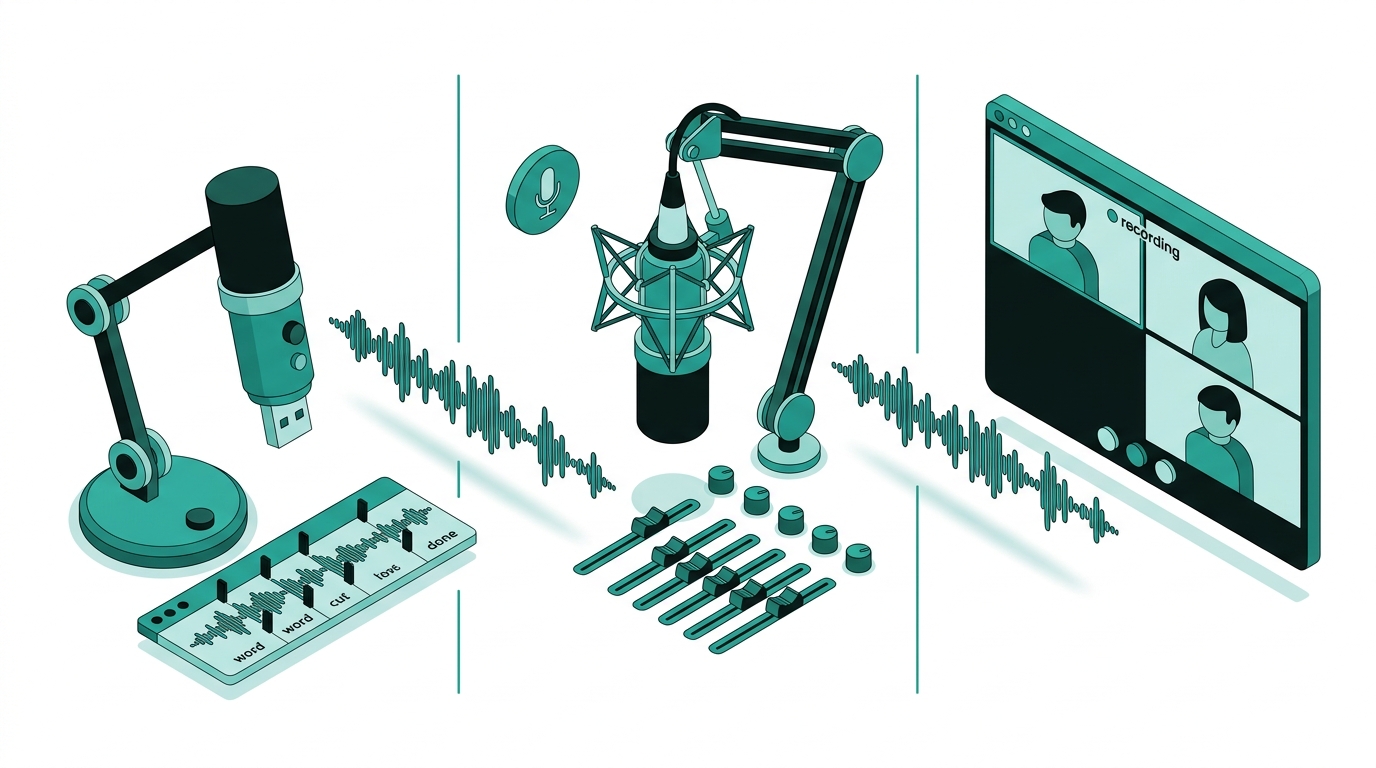
Descript wants to replace your entire post-production stack with a single text-driven editor. Adobe Podcast laser-focuses on audio enhancement and makes pristine sound accessible to anyone with a browser. Riverside.fm prioritizes lossless remote recording first, then builds editing and publishing tools around that core strength. Understanding where each tool starts changes everything about how you evaluate them.
This comparison covers verified 2025 pricing, real-world audio quality results, editing depth, AI capabilities, and collaboration features so you can make a clear, confident decision for your specific workflow.
Quick Comparison: Descript vs Adobe Podcast vs Riverside
| Feature | Descript | Adobe Podcast | Riverside.fm |
|---|---|---|---|
| Starting price (paid) | $24/month (annual) | $9.99/month | $24/month (annual) |
| Free plan | Yes (60 min/month) | Yes (30 min/file limit) | Yes (2 hrs total) |
| Audio enhancement AI | Yes (Studio Sound) | Yes (Enhance Speech v2) | Yes (Magic Audio) |
| Text-based editing | Yes (core feature) | No | Yes (Pro plan) |
| Video editing | Yes (full suite) | No | Limited |
| Remote recording | Yes | No | Yes (core feature) |
| Local track recording | No | No | Yes (per-participant) |
| Live streaming | No | No | Yes (Live plan) |
| Podcast publishing | Yes | No | Yes |
| AI voice cloning | Yes (Overdub) | No | No |
| Team collaboration | Yes (Business+) | Limited | Yes (Business) |
| Browser-based | No (desktop app) | Yes | Yes |
What is Descript?
Descript is an AI-powered audio and video editor built around a simple but powerful idea: edit your media the same way you edit a Google Doc. When you import a recording, Descript automatically transcribes it. From that point forward, deleting a word from the transcript deletes it from the audio and video simultaneously. Want to cut an entire section? Highlight the text and press delete. This text-first approach makes editing dramatically faster for anyone who finds traditional timeline editing intimidating.
Beyond transcript-based editing, Descript includes Studio Sound, its AI noise and reverb reduction engine that can clean up recordings made in non-ideal environments. It also offers Overdub, an AI voice cloning feature that lets you fix mistakes by typing corrections rather than re-recording. Filler word removal is automatic, catching every “um,” “uh,” and “you know” in seconds. Eye contact correction adjusts video to make guests appear to look directly at the camera even when they are reading notes.
For podcasters who also publish to YouTube or create social clips, Descript’s video editing tools are a genuine differentiator. The platform supports 4K export on the Creator plan and above, generates dynamic captions automatically, and includes AI clip generation to pull highlight moments for short-form content. The Creator plan costs $35/month or $24/month billed annually, with a Business plan at $50/month annually for teams that need brand controls and translation in 30 or more languages.
The main trade-off is the learning curve. Descript is not a simple tool, and first-time users typically need a few hours before the workflow feels natural. It also runs as a desktop application rather than a browser-based tool, which some users find less convenient.
What is Adobe Podcast (Adobe Enhance Speech)?
Adobe Podcast is Adobe’s web-based suite of AI-powered audio tools aimed at podcasters and content creators. Its flagship feature is Enhance Speech, which uses machine learning to remove background noise, reduce echo, and improve vocal clarity from recordings made in less-than-ideal conditions. The result is audio that sounds like it was recorded in a professional studio, even if it was actually captured on a laptop microphone in a noisy room.
Enhance Speech v2, launched in late 2024 and integrated more deeply into the editing workflow by May 2025, processes audio faster and produces cleaner results with fewer processing artifacts than the original version. Adobe reports the tool has enhanced over 100 million files to date, a figure that speaks to its accessibility and reach. Time magazine named Enhance Speech one of the Best Inventions of 2025.
The free tier of Adobe Podcast allows file uploads up to 30 minutes long with no slider control over enhancement intensity. The paid Premium plan at $9.99/month removes the time cap, adds video file support, enables batch uploads, and gives users a strength control slider. Adobe Podcast also includes a Mic Check tool that analyzes your microphone setup and gives real-time feedback before you record, a basic recorder, and simple editing tools.
What Adobe Podcast does not include is a full editing environment. There is no timeline editor, no text-based editing, no AI clip generation, and no video editing. It is purpose-built for audio enhancement and basic recording, which makes it the fastest on-ramp to cleaner sound but also the most limited in terms of end-to-end production. It integrates naturally into the broader Adobe Creative Cloud ecosystem for users already paying for that suite.
What is Riverside.fm?
Riverside.fm (now at riverside.com) is a remote podcast and video recording platform built specifically for interview-format shows. Its core differentiator is local recording: instead of capturing a compressed stream from a video call like Zoom or Google Meet, Riverside records a separate, uncompressed audio and video track directly on each participant’s device, then uploads those files to the cloud after the session ends. This approach eliminates the audio degradation that internet connection instability introduces during traditional remote recording.
The Pro plan at $24/month billed annually ($29/month billed monthly) gives hosts 15 hours of multi-track recordings per month, up to 4K video quality, 48kHz audio, unlimited text-based editing, podcast analytics, and the full suite of AI tools. These include Magic Audio for automatic noise reduction and audio leveling, Magic Clips for AI-generated highlight clips, eye contact correction, and automatic transcriptions. Direct publishing to YouTube and major podcast directories is also included.
Riverside expanded significantly in 2024 and 2025 beyond recording into editing and distribution. The Live plan ($34/month annually) adds full HD live streaming to unlimited destinations including YouTube, Facebook, LinkedIn, Instagram, X, and Twitch with custom overlays. The Webinar plan ($79/month annually) adds webinar hosting for up to 100 registrants with lead capture and HubSpot integration.
The weakness of Riverside compared to Descript is editing depth. While text-based editing on the Pro plan is solid for basic cuts, Riverside lacks the advanced AI features Descript offers for production-heavy workflows. It also does not offer voice cloning or the same level of video editing capability. For podcasters whose primary challenge is recording remote guests cleanly, however, Riverside is the most reliable purpose-built solution available.
Feature-by-Feature Breakdown
Recording Quality
Riverside.fm wins the recording quality category outright for remote interviews. Its per-participant local recording eliminates the biggest enemy of remote podcast audio: compressed internet streams. Each guest’s voice is captured at up to 48kHz audio and 4K video directly on their device, regardless of their internet connection quality during the call. The final upload produces broadcast-quality files that no amount of post-processing can replicate from a compressed Zoom recording.
Descript also supports remote recording through its Rooms feature, but it does not use local track recording in the same way. The recording quality depends more on each participant’s hardware and connection. Adobe Podcast has no dedicated remote recording feature at all; users bring their own recordings to the platform for enhancement.
For solo podcasters recording directly into a good microphone in a quiet room, all three tools are adequate. The recording quality difference between Descript and Adobe Podcast in this scenario comes down to the microphone and environment, not the software.
Editing Features
Descript is the clear winner for editing depth. Text-based editing is its core identity, and no other tool in this comparison matches it for speed of cutting, rearranging, and cleaning up a transcript. Filler word removal, gap shortening, and silence removal are one-click operations. The platform also includes a full timeline editor for users who prefer traditional audio or video editing approaches. Video editing at up to 4K, clip generation, dynamic captions, and social media export templates make Descript the only true end-to-end production platform of the three.
Riverside’s text-based editing on the Pro plan is genuinely useful for basic cuts and removes the need to scrub a waveform for specific moments. It is not as deep as Descript’s, and it does not include video editing in a meaningful sense. Adobe Podcast’s editing tools are minimal. Users can make basic cuts and adjustments, but the platform is not designed to be a primary editing environment. It works best as a final processing step before moving audio into a dedicated editor.
AI Capabilities
Each tool leads in a distinct AI category. Descript’s Overdub voice cloning is the most unique AI feature in this comparison. It allows creators to fix recording mistakes by simply typing the correct words, and the AI generates speech in the creator’s voice. Studio Sound handles noise and reverb reduction. AI eye contact correction adjusts video in post. AI clip generation identifies highlight moments and creates short-form content automatically.
Adobe Podcast’s AI strength is audio enhancement specifically. Enhance Speech v2 is among the best single-purpose audio cleaning tools available and is free for files under 30 minutes. Independent testing from podcast production companies has found that Descript Studio Sound produces slightly more natural results than Adobe Enhance Speech when both are pushed to similar processing levels, noting that Adobe’s output can sound overly compressed and muddy. That said, Adobe Enhance Speech is faster to use for a standalone file cleanup task.
Riverside’s Magic Audio automatically levels and cleans audio from all participants after a recording session. Magic Clips uses AI to suggest the best segments for short-form content. These are solid, practical AI features that fit neatly into Riverside’s recording-first workflow. Eye contact correction is also included, matching Descript’s offering in that specific area.
Pricing
Adobe Podcast is the most affordable paid option at $9.99/month, and its free tier handles files up to 30 minutes with no cost. For solo creators who only need audio enhancement and basic recording, this is excellent value.
Descript’s Creator plan costs $35/month or $24/month billed annually. The Hobbyist plan at $16/month annually is a cheaper entry point but limits media to 10 hours per month and restricts some AI features. The Business plan for teams runs $50/month per user annually. There is a free plan with 60 minutes of media and 100 one-time AI credits, useful for evaluation but not for ongoing production.
Riverside’s Pro plan is $29/month or $24/month billed annually, putting it at the same annual price point as Descript Creator. The free plan gives 2 hours of total multi-track recording, which is enough for a trial session but not ongoing use. The Live plan at $34/month annually adds streaming. Teams with heavier production needs need the Business plan with custom pricing.
For value per dollar, Descript Creator and Riverside Pro are roughly equivalent in annual cost but serve different needs. Adobe Podcast wins purely on price, though its scope is far narrower.
Collaboration
Adobe Podcast’s browser-based interface makes it the easiest to share with team members who lack technical editing experience. Anyone can upload a file and run Enhance Speech without training. However, it lacks structured collaboration features like shared projects, commenting, or role-based access control.
Descript’s Business plan adds Brand Studio for team-wide style consistency, team asset libraries, and priority support with a service level agreement. Collaboration is built into the platform at higher tiers, making it suitable for production teams with editors, producers, and hosts working on the same project.
Riverside’s Business plan offers collaborative editing, production workspaces, async recording workflows, unlimited storage, and a Producer mode for live session management. Its producer mode is particularly useful for teams recording live shows where one person manages guests and audio while another handles the content.
Who Should Use Which?
Choose Descript if you produce weekly podcast episodes and also publish video content to YouTube or social media. Descript’s all-in-one model, covering recording, editing, AI enhancement, captions, video production, and clip generation, saves the most time for creators with heavy, regular output. It is also the right choice for anyone who wants voice cloning to fix mistakes without re-recording, or for teams that need a shared production environment with brand controls.
Choose Adobe Podcast if you already have an established recording workflow and just need fast, reliable audio cleanup before publishing. At $9.99/month, it is the lowest-cost way to get genuinely good AI audio enhancement. It is also ideal for beginners who find full editing platforms overwhelming, for non-podcasters who occasionally need to clean up audio from presentations or interviews, or for Adobe Creative Cloud subscribers who want a tool that fits their existing ecosystem without adding a separate subscription at full price.
Choose Riverside.fm if your podcast is primarily an interview show with remote guests. The local-track recording advantage alone justifies the Pro plan cost for anyone who has experienced the audio quality drop that comes with recording remote calls through Zoom or Teams. Riverside is also the best choice for creators who want to live stream their podcast recordings and repurpose that content across multiple platforms simultaneously.
Some creators use two of these tools together. A common workflow pairs Riverside for recording with Descript for editing, getting the best local-track quality from Riverside and the most efficient editing experience from Descript. Adobe Podcast can slot in as a quick standalone cleanup tool for files that need enhancement before entering either workflow.
Verdict
For most podcasters, Descript is the strongest all-around tool. Its text-based editing genuinely changes how fast you can produce an episode, the AI feature set is the deepest of the three, and it handles both audio and video in one application. The Creator plan at $24/month annually represents good value for any creator publishing regularly.
Riverside.fm is the better choice for remote interview podcasters who prioritize recording quality above everything else. If your show lives or dies by the audio quality of your guests, Riverside’s local-track recording is a fundamental advantage that no amount of post-processing can fully replicate.
Adobe Podcast occupies a specific and useful niche as a low-cost, high-quality audio enhancement tool. It is not trying to replace Descript or Riverside. For creators on a tight budget, beginners finding their footing, or anyone who just needs to clean up an audio file quickly, Adobe Podcast and its Enhance Speech v2 tool are genuinely impressive at $9.99/month.
There is no single wrong answer here. The right tool is the one that solves your actual bottleneck: editing speed, recording quality, or audio enhancement on a budget.
Frequently Asked Questions
Is Descript or Adobe Podcast better for beginners?
Adobe Podcast is easier for beginners. It runs entirely in a browser with no installation required, and Enhance Speech works by simply uploading a file and clicking a button. Descript has more features but a steeper learning curve that takes several hours to get comfortable with.
Can I use Adobe Podcast for free?
Yes. Adobe Podcast offers a free tier that processes audio files up to 30 minutes long with Enhance Speech. The free plan does not include the intensity slider control, video file support, or batch uploads. Those features require the $9.99/month Premium plan.
Does Descript replace Riverside for remote recording?
Not entirely. Descript supports remote recording through Rooms but does not use local-track recording from each participant’s device the way Riverside does. For high-quality remote interviews, Riverside’s per-participant local files produce superior audio that does not depend on internet connection stability during the call.
What is Descript Studio Sound and how does it compare to Adobe Enhance Speech?
Both are AI tools that remove background noise and improve vocal clarity. Independent testing by podcast production professionals has found that Descript Studio Sound produces slightly more natural-sounding results with fewer artifacts. Adobe Enhance Speech can sound overly compressed when pushed to high enhancement levels. Descript Studio Sound is integrated into the full editing workflow; Adobe Enhance Speech is a standalone upload-and-process tool.
Does Riverside.fm include podcast hosting?
Podcast hosting is available on the Business plan with unlimited storage. The Pro and Live plans include publishing integrations to YouTube and major podcast directories, but dedicated unlimited podcast hosting is a Business-tier feature.
Can I use all three tools together?
Yes, and some creators do. A popular workflow is to record with Riverside for the best remote audio quality, edit in Descript for its text-based tools and AI features, and optionally run specific files through Adobe Enhance Speech for a final polish pass if needed. The tools do not conflict with each other because they operate at different stages of production.
Is Adobe Podcast the same as Adobe Audition?
No. Adobe Audition is a professional digital audio workstation (DAW) included with Adobe Creative Cloud, aimed at audio engineers and advanced editors. Adobe Podcast is a separate, simpler web-based tool focused on AI audio enhancement, basic recording, and podcasting workflows. They are separate products with different price points and user profiles.
Which tool is best for video podcasting?
Descript is the clear winner for video podcasting. It supports 4K video export on the Creator plan, includes a full video editor alongside audio editing, generates dynamic captions automatically, and produces AI clips for social media. Riverside handles video recording well but has limited editing for the final video output. Adobe Podcast does not include video editing at all.
How does Riverside Magic Audio compare to Descript Studio Sound?
Both tools use AI to automatically clean up audio from recordings. Riverside Magic Audio runs automatically after a recording session and levels all participants’ audio simultaneously. Descript Studio Sound gives users more manual control with an adjustable intensity slider from 1 to 100 percent and integrates with the full editing workflow. For Riverside users, Magic Audio is a convenient automatic first pass; Descript gives more precise control over the enhancement level.
Whichever platform you start with, the best podcast editing tool is the one you will actually use consistently. All three options in this comparison offer free tiers that let you test the core features before committing to a paid plan. Start with the free version of the tool that best matches your current workflow, and upgrade only when the limits become a genuine obstacle to your production schedule.
For a deeper look at Descript on its own, see our full Descript review covering its complete feature set. If you are still narrowing down your overall toolkit, our guide to the best AI writing tools is a useful next step for rounding out your content production stack.