Key Takeaways
- AI SDR agents go beyond email automation: they prospect, research, personalize, handle replies, and book meetings without a human in the loop at every step.
- The AI SDR market was valued at approximately $4.2 billion in 2025 and is forecast to reach $15 billion by 2030.
- 11x Alice sent nearly 3 million messages and generated roughly 21,000 replies by January 2025, with a reply rate around 2%, on par with many human SDRs.
- AiSDR starts at $900/month with unlimited seats, making it one of the more accessible options for small and mid-market teams.
- Artisan Ava has a 300M+ contact database but consistently draws complaints about generic messaging and rigid annual contracts.
- Fully autonomous AI SDRs tend to produce 0.5-1.5% reply rates; hybrid AI-plus-human setups report 2-4% reply rates on average.
- Agent Frank by Salesforge operates in both autopilot and co-pilot modes, starting at $499/month, making it one of the lowest entry points among true AI SDR agents.
- Regie.ai positions itself as an AI sales engagement platform (AI SEP), not just an SDR, covering over 100 built-in intent signals across email, phone, and LinkedIn from a single workflow.
- Most tools require annual contracts; only a handful offer monthly billing or self-serve trials, so budget expectations should include a 12-month commitment.
Outbound sales development has always been a numbers game. SDRs send hundreds of cold emails, make dozens of calls, and spend hours researching prospects – all to book a handful of qualified meetings each month. The industry benchmark sits at around 15 meetings per month for a solid SDR, with only 12 of those typically showing up. That is a lot of manual effort for relatively thin yield.
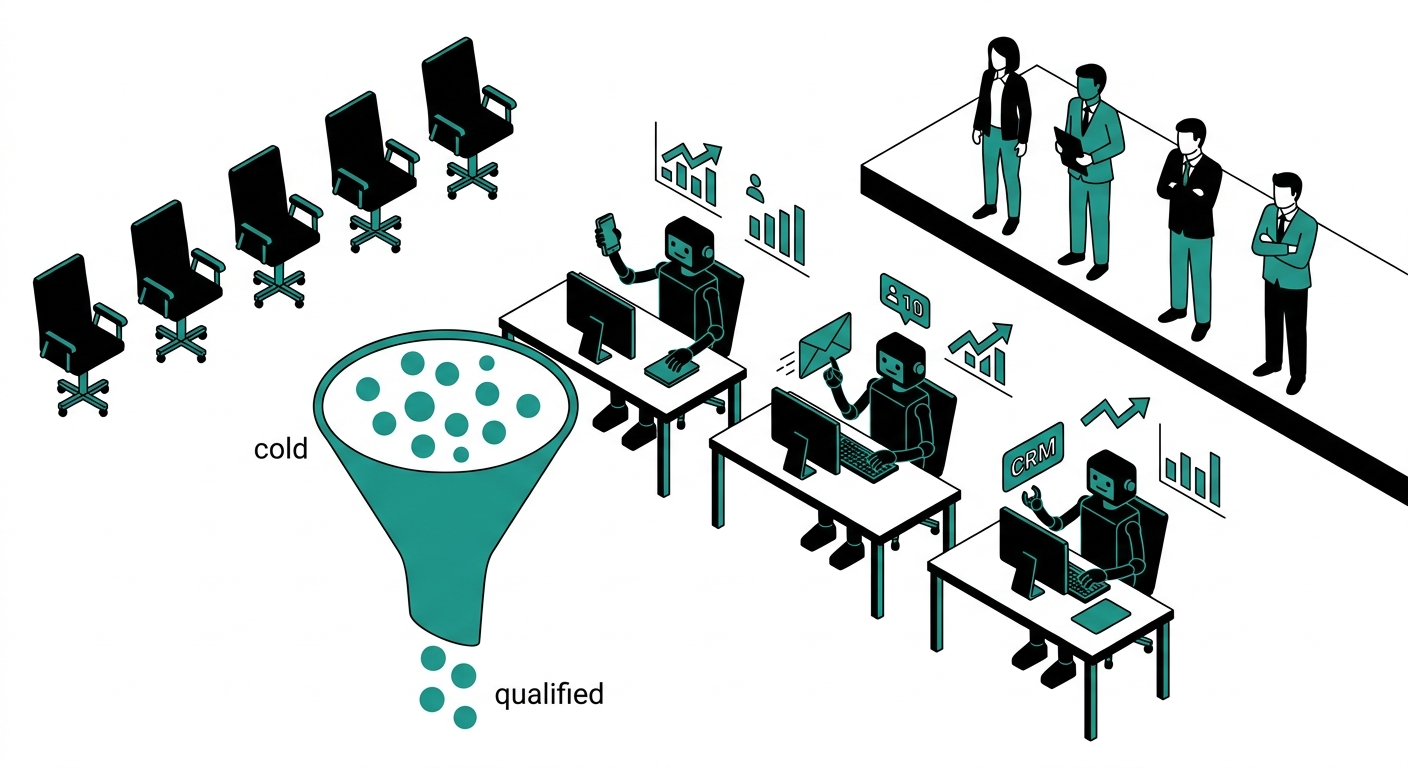
AI SDR agents promise to change the math. Instead of replacing a sequence tool or adding another data enrichment layer, they attempt to handle the entire top-of-funnel workflow: finding prospects that match your ICP, researching them across LinkedIn and company data, writing personalized outreach, managing replies, and routing warm leads to your closers. The category has matured quickly since 2023, and there are now real results – and real limitations – to weigh.
This article covers the nine best AI SDR agents available right now, based on actual feature sets, published pricing, and honest user feedback from sales communities and review platforms.
What Makes an AI SDR Agent Different from Email Automation
A standard email automation tool – think sequences in HubSpot, Mailchimp, or a basic cold email sender – does one thing: it sends pre-built templates to a contact list on a schedule. You provide the list, you write the copy, and the tool sends email A on day one, email B on day four, and so on. It has no awareness of what is happening in the conversation and no ability to adjust based on context.
An AI SDR agent is a fundamentally different product. According to analysis from Apollo’s product team, the core difference is scope and intelligence. An AI SDR handles the entire top-of-funnel workflow and applies decision-making at every stage:
- Prospect identification: The agent finds leads that match your ICP from its own database or connected sources, rather than waiting for you to upload a list.
- Research and personalization: It pulls context from LinkedIn, company news, funding announcements, and web activity to write outreach that references something specific about that person or company.
- Multi-channel sequencing: Most AI SDR agents run email, LinkedIn messages, and sometimes SMS or phone in coordinated sequences.
- Reply handling: The agent reads incoming responses, classifies them (interested, not interested, not now, out of office), and responds to simple inquiries or routes hot leads to a human rep.
- Meeting booking: When a prospect says yes, the agent books the calendar slot directly.
The result is a system that can theoretically run outbound at scale without a human managing every touchpoint. Whether that works well in practice depends heavily on the tool and how well your ICP is defined.
The 9 Best AI SDR Agents in 2026
1. 11x Alice

11x Alice is one of the earliest and best-known names in the autonomous AI SDR category. The platform frames Alice as a “digital worker” that operates 24/7, running the full outbound cycle: finding leads, researching them, writing personalized emails and LinkedIn messages, handling replies, and booking meetings directly to a calendar.
By January 2025, Alice 2.0 had sent close to 3 million messages and generated approximately 21,000 replies (source: SyncGTM), with a reply rate around 2% – comparable to many human SDR benchmarks. The platform uses a multi-agent architecture, with specialized agents for research, copywriting, and outreach management working in parallel.
Strengths include strong onboarding support, solid ICP targeting, and a multichannel approach that covers both email and LinkedIn. The biggest drawbacks are opaque pricing, limited analytics visibility, and occasional complaints about message quality feeling generic in competitive verticals. 11x also offers Julian, an AI phone rep, but reviewers note it struggles with complex objections and non-standard accents.
Pros: Multichannel (email + LinkedIn), strong onboarding, 24/7 operation, self-learning over time.
Cons: Enterprise-only pricing, no free trial, analytics gaps, message quality can be inconsistent.
Pricing: Custom only. User reports on G2 suggest $5,000 to $15,000+ per month depending on volume and contract terms. No self-serve signup is available.
2. AiSDR

AiSDR takes a quality-over-volume approach. Rather than blasting large prospect lists, it uses over 300 contextual data sources to build highly personalized outreach sequences. The platform covers email, LinkedIn, and SMS from a single interface and manages the full conversation lifecycle – from first touch through reply handling and meeting booking.
One standout differentiator is the CRM intelligence layer. AiSDR pulls data from your existing HubSpot records to personalize outreach based on past interactions, which helps avoid contacting existing customers or mismatched prospects. The native lead database includes 300M+ contacts, so you do not need a separate data provider to get started.
Case studies on the AiSDR site show meaningful results: one client (GIOS) ran a multichannel sequence and booked 13 meetings from roughly 1,000 emails sent, a strong 1.3% meeting rate. Per-meeting costs from published data run roughly $140 to $300 depending on the plan.
Pros: Unlimited seats on all plans, HubSpot integration, strong reply handling, SMS + LinkedIn + email in one tool.
Cons: Quarterly billing required (no month-to-month), higher entry price than some alternatives.
Pricing: Explore plan at $900/month, Grow plan at $2,500/month, Enterprise pricing on request. Annual billing gives a 20% discount.
3. Artisan (Ava)

Artisan’s AI SDR, Ava, made headlines for its aggressive marketing and provocative San Francisco billboard campaigns. The product itself centers on high-volume outreach from a proprietary 300M+ B2B contact database, with AI-generated email sequences, email warmup infrastructure, and intent signal tracking (funding news, hiring announcements, website visits).
Ava is designed for teams that want to maximize outreach volume and treat AI as a full SDR replacement rather than an assistant. It handles lead sourcing, sequence execution, and basic deliverability management automatically. The website visitor retargeting feature – which identifies anonymous visitors and adds them to outreach campaigns – is a practical addition that most competitors lack.
However, Artisan draws consistent criticism in sales communities. Multiple reviewers describe Ava’s emails as “AI slop” – clearly machine-generated and lacking depth. Ava also cannot autonomously reply to incoming emails; it can only suggest responses, meaning a human still needs to manage conversations once someone replies. The platform also faced a temporary LinkedIn ban from December 2024 to January 2025. Annual-only contracts with auto-renewal create additional friction for buyers who want to exit.
Pros: Large contact database, email deliverability tools, website visitor retargeting, intent signal monitoring.
Cons: Cannot autonomously reply to emails, message quality complaints, annual-only contracts, past LinkedIn ban.
Pricing: Employee self-serve plan at $600/month (billed annually). Enterprise pricing requires contacting sales. Annual contract required on all plans.
4. Agent Frank by Salesforge

Agent Frank is Salesforge’s AI SDR product, built natively on top of the company’s cold email infrastructure stack. This means Frank operates within already-warmed inboxes and custom sending domains, which gives it a deliverability advantage over tools that treat sending infrastructure as an afterthought.
Frank supports both autopilot mode (fully autonomous outreach) and co-pilot mode (agent drafts everything, human approves before sending). This flexibility makes it a reasonable choice for teams that are not ready to hand off full control but still want to eliminate most of the manual SDR work. The platform handles lead sourcing, data enrichment, email and LinkedIn outreach, reply management, and meeting booking. It supports 20+ languages, which matters for teams running international campaigns.
Pricing is among the most accessible in the category. The $499/month entry plan covers 1,000 active contacts and sends roughly 6,000 to 7,500 emails per month. Unlimited mailboxes and LinkedIn sender accounts are included, which helps teams scale sending volume without adding per-seat costs.
Pros: Strong deliverability infrastructure, co-pilot and autopilot modes, 20+ languages, unlimited mailboxes, accessible pricing.
Cons: Less known than larger competitors, fewer third-party integrations than enterprise tools.
Pricing: Starting at $499/month (billed annually) for 1,000 active contacts. Monthly billing at $599/month per 1,000 contacts.
5. Regie.ai

Regie.ai describes itself as an AI Sales Engagement Platform (AI SEP), positioning the product as broader than a single AI SDR agent. The platform monitors over 100 built-in intent signals from sources including Google, LinkedIn, company filings, and website behavior. These signals trigger outreach automatically, so prospects receive messages when they are most likely to be in-market rather than on a fixed schedule.
The native database includes 220M+ contact records with firmographics and intent data, eliminating the need for a separate enrichment provider. All channels – email, phone, and LinkedIn – run from a single workflow, and AI agents handle personalization, sequencing, and reporting. The Force Multiplier Rep plan adds a dedicated AI agent that operates more autonomously, closer to what most people mean by “AI SDR.”
The main limitation is cost. The AI SEP plan requires a minimum of 10 seats, which means a $21,600 annual commitment before add-ons. This makes Regie a better fit for established sales teams than for early-stage companies or solo founders.
Pros: 100+ intent signals, native contact database, all-channel workflow, strong personalization at scale.
Cons: 10-seat minimum, high entry cost for small teams, learning curve on custom signal setup.
Pricing: AI SEP at $180/user/month (10-seat minimum, $21,600/year minimum). Force Multiplier Rep at $499/user/month.
6. Reply.io (Jason AI)

Reply.io is one of the longer-standing sales engagement platforms in the market, and Jason AI is the AI SDR layer built on top of it. Jason handles outreach personalization, follow-up sequencing, and basic reply classification across email, phone, SMS, and WhatsApp. The multi-channel reach is broader than most competitors, and WhatsApp support in particular makes Reply.io interesting for teams selling into European or APAC markets where WhatsApp is a primary business communication channel.
The platform integrates with Salesforce, HubSpot, Pipedrive, and a range of other CRMs via native connectors. Jason AI can generate initial messages and suggest follow-up content, though the level of autonomy is lower than tools like 11x or AiSDR – Jason is more of an AI-powered co-pilot than a fully autonomous agent in most configurations.
Reply.io’s pricing is among the most transparent in the category, with published plans and no requirement to talk to sales to get started. The AI SDR Starter package is accessible for teams that want to test the concept before committing to a larger annual contract.
Pros: WhatsApp + SMS + email + phone coverage, transparent pricing, CRM integrations, long track record.
Cons: Less autonomous than dedicated AI SDR tools, UI can feel dated in some workflows.
Pricing: AI SDR Starter from $500/month for 500 active contacts. Scales to $1,500/month for 3,000 active contacts.
7. Amplemarket

Amplemarket is an all-in-one outbound platform that has added AI SDR capabilities through its Duo Copilot and autonomous agent features. The platform’s standout claim is phone number accuracy – the company reports 90% phone accuracy, compared to roughly 65% for Apollo, which translates to significantly fewer wasted dials on dead-end numbers.
The competitive intelligence layer is a practical differentiator. Rather than simply telling you that a prospect’s company is researching CRM software, Amplemarket can surface more specific behavioral signals – such as which competitor’s pricing page a prospect visited – giving sales reps context that improves conversation quality. The platform covers email, LinkedIn, and phone, with conditional sequences that adapt based on prospect behavior (opening an email, clicking a link, visiting a page).
Deliverability issues at scale have been a recurring user complaint, with some reporting increased spam placement after ramping up sequence volume. Data accuracy, while strong, still produces stale contacts in a meaningful share of records. Pricing is higher than pure email tools but reasonable for a platform that combines data, sequencing, and AI in one place.
Pros: High phone accuracy, competitive intelligence signals, conditional sequences, multichannel in one platform.
Cons: Deliverability issues at high volume, stale contacts reported by some users, no month-to-month billing.
Pricing: Startup plan at $600/month (annual billing, 2 users). Growth and Elite plans on custom pricing. Estimated $1,500 to $3,000+/month for most teams.
8. Smartlead (SmartAgents)

Smartlead built its reputation on deliverability infrastructure and cold email sequencing. The SmartAgents layer, added more recently, brings autonomous AI SDR capabilities on top of that foundation. SmartAgents are configured in plain language – you describe what you want the agent to do, pick a trigger condition, and the agent executes autonomously. Use cases include pulling campaign performance data and posting it to Slack, adding prospects who match specific criteria to outreach sequences, or firing a follow-up action the moment a lead replies.
Smartlead also includes SmartProspect for verified B2B lead data, SmartDialer for AI-assisted calls, and a unified master inbox that consolidates replies from all sender accounts. The platform reports being trusted by 100,000+ businesses, which gives it a wider real-world testing base than most newer AI SDR tools.
SmartAgents are newer than some competitors’ autonomous features and have fewer published case studies showing meeting-booked outcomes. Teams that primarily want a proven cold email infrastructure with AI agent capabilities bolted on will find Smartlead compelling; teams looking for a purpose-built autonomous SDR may prefer 11x or AiSDR.
Pros: Strong deliverability infrastructure, flat pricing, large user base, plain-language agent configuration.
Cons: AI SDR features are newer, fewer published outcome case studies, SmartAgents still maturing.
Pricing: Basic plan at $39/month (sequences only). Pro plans with SmartAgents start at $94/month. Volume-based add-ons available.
9. Topo.io

Topo.io is a purpose-built autonomous AI SDR platform that positions itself as one of the most hands-off options available. The platform trains a custom AI agent on your specific sales methodology, ICP, messaging framework, and objection handling patterns. That trained agent then runs outbound end-to-end: prospecting through industry-specific channels, writing personalized outreach, managing the reply thread, and handing off qualified leads to human closers.
The custom-training approach is Topo’s clearest differentiator. Rather than a generic AI writing cold emails, you’re deploying an agent that has been built to sound like your best SDR. The platform identifies high-quality leads through channels that go beyond basic LinkedIn scraping – including niche industry directories, job boards, and company tech stack data – which can surface prospects that commodity lead databases miss.
Topo targets teams that want full autonomy and are willing to invest in the setup process. Pricing is not publicly listed, and access requires a sales conversation. User reviews on G2 are positive but limited in volume, making it harder to assess real-world performance across a wide range of use cases compared to more established tools.
Pros: Custom-trained AI agent, deep ICP targeting, end-to-end autonomy, industry-specific prospecting channels.
Cons: Pricing not public, limited public case studies, setup overhead higher than plug-and-play tools.
Pricing: Custom pricing only. Contact for a demo. G2 pricing page lists plans but no public figures.
How to Choose the Right AI SDR Agent for Your Team
The right tool depends on three things: your team size, your ICP clarity, and how much autonomy you actually want.
If you have a well-defined ICP and want full autonomy, 11x Alice or Topo.io make sense. Both are built for teams that can clearly describe a “qualified prospect” in one sentence and want the agent to run without constant supervision. The trade-off is cost (11x) or setup time (Topo).
If you want quality over volume and have a HubSpot CRM already in use, AiSDR is worth testing. The CRM integration and 300-source personalization layer produce better-qualified outreach than tools that spray and pray against large lists.
If you want the lowest entry price with a meaningful feature set, Agent Frank by Salesforge at $499/month is the most accessible option that still includes genuine AI SDR capabilities rather than just smart sequencing.
If your team is selling into international markets with WhatsApp as a common business channel, Reply.io Jason AI is the only major option covering that channel natively.
If you need phone data accuracy and competitive intelligence, Amplemarket’s 90% phone accuracy claim is backed by user feedback and stands out against Apollo’s roughly 65% benchmark.
Realistic Performance Expectations
Sales communities have been blunt about what AI SDRs actually deliver. Data from multiple sources shows that fully autonomous AI SDR setups produce reply rates in the 0.5-1.5% range, while hybrid AI-plus-human teams report 2-4%. Best-in-class human SDR teams with AI assistance reach 8-15%.
The tools that deliver the best ROI are typically deployed not as complete human replacements but as a way to eliminate the lowest-value work (list building, template writing, follow-up scheduling) so human reps can focus on conversations that actually need judgment.
The AI SDR market is projected to reach $15B by 2030 (from $4.12 billion in 2025), which reflects genuine demand – but the category is also known for aggressive marketing claims that often outpace actual results. Treat any tool’s “meetings booked” case studies as best-case scenarios, not typical outcomes.
Frequently Asked Questions
What does an AI SDR agent actually do?
An AI SDR agent handles the top-of-funnel outbound sales workflow autonomously. That includes finding leads that match your ICP, researching those prospects, writing personalized outreach messages, managing follow-up sequences across email and LinkedIn, reading and responding to replies, and booking meetings. The key difference from a standard email tool is that the AI reads context and makes decisions at each step rather than following a fixed schedule.
Can an AI SDR really replace a human SDR?
For high-volume, low-complexity outbound with a well-defined ICP, AI SDR agents can handle most of the mechanical work a human SDR does. However, industry data shows that fully autonomous AI SDRs produce lower reply rates than hybrid models. Complex sales with long buying cycles, multiple stakeholders, or high deal values still benefit from human judgment, especially once a prospect is engaged in a real conversation. Most teams that get the best results use AI to run volume and route warm leads to humans.
How much does an AI SDR agent cost?
Pricing ranges from around $499/month (Agent Frank by Salesforge) to $15,000+/month (11x at the enterprise tier). Most tools with meaningful autonomous capabilities fall in the $900 to $2,500/month range. Many require annual contracts, so the true commitment is typically $10,000 to $30,000 per year before you factor in add-ons or extra contact credits.
What reply rates should I expect from an AI SDR?
Industry data suggests fully autonomous AI SDR tools produce reply rates of 0.5-1.5% at scale. Tools with better personalization (such as AiSDR, which pulls from 300+ data sources) can push higher in specific campaigns. Published case studies from vendors often show best-case outcomes of 1-3% meeting rates per email sent. These numbers vary significantly by industry, ICP fit, and offer clarity.
Do AI SDR tools work for all industries?
They work best in B2B SaaS, professional services, and technology sectors where prospects are reachable by email and LinkedIn and where the ICP can be described precisely. They are less effective in industries where buying decisions are highly relationship-driven (enterprise government contracts, for example) or where the prospect pool is very small and hyper-targeted.
What is the risk of using an AI SDR for cold outreach?
The main risks are deliverability damage (sending high volumes from new domains can burn inboxes quickly), brand damage if messages feel generic or target the wrong people, and compliance risk if the tool does not handle unsubscribes and GDPR opt-outs correctly. Tools like Salesforge’s Agent Frank mitigate deliverability risk by using pre-warmed infrastructure; others leave this entirely to the buyer.
Is there a difference between an AI BDR and an AI SDR?
In practice, most tools use the terms interchangeably. Technically, SDRs focus on outbound prospecting and booking meetings, while BDRs (Business Development Representatives) may also handle inbound qualification or partner-related pipeline. Most AI SDR products focus on outbound-first prospecting and treat BDR as a synonym. If a vendor emphasizes inbound qualification – like Qualified’s Piper – that leans more toward AI BDR territory.
Can I test an AI SDR before committing to a contract?
Most enterprise-tier tools (11x, Topo.io, Artisan) require sales conversations and annual contracts with no free trial. AiSDR and Reply.io offer demos and, in some cases, limited trial access. Agent Frank by Salesforge is one of the more accessible options for testing because it offers shorter billing cycles and a lower entry price. Always ask vendors specifically about pilot programs before signing an annual agreement.
Bottom Line
AI SDR agents have moved past early hype into a category with real, measurable results – though those results vary widely depending on how the tool is deployed and how clearly a team has defined its ICP. The best outcomes consistently come from hybrid approaches: AI handles prospecting, sequence execution, and initial reply management, while humans take over once a genuine conversation starts.
For most teams in 2026, the right starting point is a tool that fits your current stack and budget rather than the one with the biggest marketing presence. Agent Frank and AiSDR offer strong starting points for smaller teams; Regie.ai and 11x Alice make more sense for organizations with dedicated RevOps resources and higher budgets. Whichever you choose, set realistic expectations around reply rates, give the tool at least 60 days to train on your ICP, and track cost-per-meeting as your primary ROI metric.