Key Takeaways
- AI personal trainer apps with form tracking use computer vision to monitor up to 25 skeletal joints in real time, providing form corrections at approximately 92% accuracy using a smartphone camera, no special equipment required for most apps in this category.
- Zing Coach is the most effective consumer app for actual real-time form correction using computer vision. It monitors bodyweight exercises, squats, push-ups, lunges, planks, via a phone propped against a wall, counting reps and correcting posture in real time. Pricing starts at approximately $5/month billed annually.
- Ray AI is the strongest app for active coaching during workouts, delivering voice guidance through headphones with computer vision rep counting, rest period timing, and in-workout adjustments. At $19.99/month it is the most comprehensive AI training experience short of a human trainer.
- Tempo is the most advanced form tracking system in the category but requires Tempo’s proprietary home gym hardware, a large display unit with built-in camera and weight detection. The form correction it delivers is the most accurate of any platform tested, but the hardware cost and $39/month subscription make it a premium commitment.
- Fitbod at $12.99/month or $79.99/year provides the strongest strength training programming with exercise video demonstrations and a computer vision form scoring system (0 to 100) that gives objective progress tracking on technique quality over time.
- SensAI is built for users with fitness trackers who want an AI coach that reasons about HRV, sleep quality, and training load together, which adjusts programming based on recovery status rather than just scheduled workouts.
- Arvo at €4/month is the best value full AI coaching app in the category for users who want personalized workout programming without form tracking as a priority. Future at $250/month delivers the highest accountability through human coaches with app-based communication if the premium is justified by your training goals.
Form tracking is the capability that separates AI personal trainer apps from AI workout planning apps. Any app can generate a workout plan from your goals and fitness level. Very few can watch you do a squat, identify that your knees are caving inward, and correct the movement before you finish the set.
The apps that can do this use computer vision running on your phone’s camera: the same pose estimation technology used in physical therapy, sports performance analysis, and professional strength coaching, packaged into a consumer subscription at a price point that makes personal training economics accessible to anyone with a smartphone.
This guide covers the seven best AI personal trainer apps with form tracking in 2026, with honest assessment of which apps’ form correction actually works, what each one costs, and which type of user each one serves best.
How AI Form Tracking Works
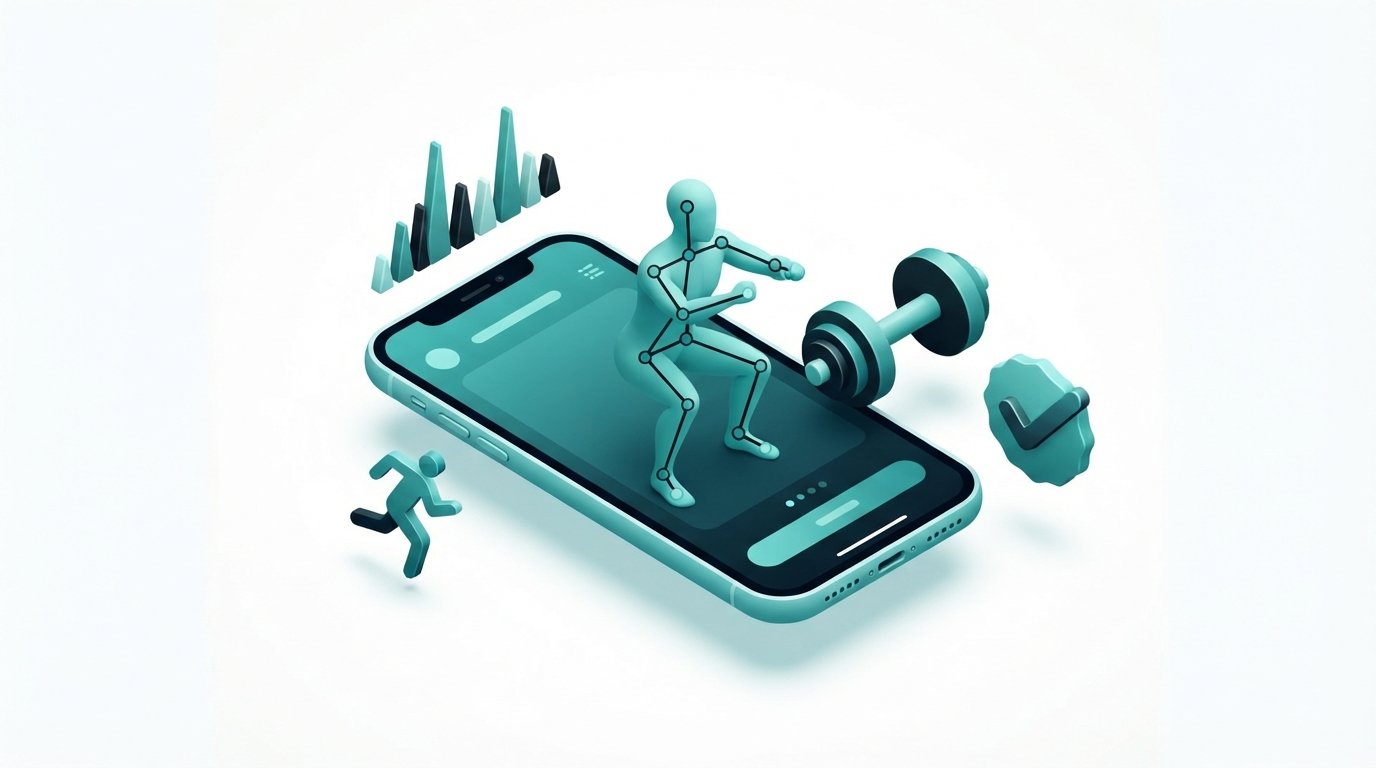
AI form tracking in fitness apps uses pose estimation: a computer vision technique that identifies the location of body joints from camera input, to build a real-time skeletal model of your movements during exercise. Modern pose estimation models in consumer fitness apps track 17 to 25 skeletal joints simultaneously, enabling the app to measure joint angles, range of motion, movement speed, and alignment throughout each repetition.
The app compares your movement pattern against a reference model for correct form for that exercise, identifies deviations, knees caving, back rounding, incomplete range of motion, uneven weight distribution, and provides feedback either as on-screen visual cues or voice coaching through headphones. Independent testing of the leading apps in this category finds form correction accuracy at approximately 92% for well-supported exercises, with accuracy dropping for exercises with unusual setup requirements or limited training data in the model.
The practical setup for most apps is straightforward: prop your phone against a wall or gym equipment at the appropriate angle for the exercise, start the workout, and train in the camera’s field of view. No additional hardware is required for software-based form tracking, though hardware-integrated systems like Tempo deliver more accurate tracking through dedicated sensors alongside the camera.
Best AI Personal Trainer Apps With Form Tracking in 2026
1. Zing Coach: Best for Real-Time Form Correction
Zing Coach is the consumer fitness app where computer vision form correction does the most meaningful work. Its camera-based tracking monitors bodyweight exercises including squats, push-ups, lunges, and planks in real time, counting reps, tracking range of motion, and correcting form with specific feedback rather than generic reminders. The setup requires propping your phone against a wall at the appropriate height for the exercise, the app guides you through camera positioning before each session.
Zing Coach’s form feedback is delivered as on-screen visual overlays showing your joint positions alongside the target positions, with specific text corrections for identified deviations. For bodyweight training at home or in a gym where your phone has a clear line of sight to your workout area, the form correction quality is the best available in a software-only consumer app.
The limitation is exercise scope: Zing’s computer vision performs best on bodyweight and calisthenics movements. Barbell exercises, cable movements, and exercises where the camera view is partially obscured produce less reliable tracking. For home bodyweight training and beginner fitness, this scope covers the most common exercise needs effectively.
Pricing: Approximately $5/month billed annually, or $19/month on a monthly plan. Free trial available.
2. Ray AI: Best for Active Voice Coaching
Ray AI delivers the most complete active coaching experience of any app in this category, delivering not just form tracking, but a full workout coaching session via voice through your headphones, as if a trainer were in the room. It counts reps with computer vision for supported movements, cues rest periods, and allows in-workout adjustments (“make this harder,” “my shoulder hurts”) that modify the session in real time based on feedback given during the workout.
The voice coaching architecture is Ray’s defining feature. Rather than viewing form feedback on a screen while exercising, Ray coaches in real time through audio, so you hear “your depth is good but try to keep your chest up” without looking away from the exercise. For users who find screen-based feedback disruptive to training flow, Ray’s audio-first approach is more natural and actionable than visual overlays.
Ray integrates computer vision rep counting for exercises where camera angle allows it, and applies AI reasoning to workout programming based on your history, fatigue signals, and stated goals. The $19.99/month pricing positions it as a premium consumer app, below the cost of a human personal trainer session but above the basic subscription tier of the other apps in this comparison.
Pricing: $19.99/month. Best for users who want the closest approximation to a real-time AI coaching session during workouts.
3. Tempo: Best for Hardware-Integrated Form Correction
Tempo is a home gym system where AI form correction is integrated into proprietary hardware, a large screen unit with a built-in camera array and in-platform weight detection, rather than delivered through a smartphone. The hardware integration allows Tempo to track barbell, dumbbell, and kettlebell movements with form accuracy that exceeds what smartphone camera pose estimation can achieve, because the dedicated sensor array provides multi-angle capture and weight data alongside visual tracking.
Tempo’s form correction covers a much broader exercise library than software-only apps, including loaded compound movements like deadlifts, bench press, and overhead press where smartphone tracking is unreliable. The system measures bar path, rep speed, range of motion, and bilateral symmetry, the full technical picture of strength training form quality that a human coach would evaluate.
The cost structure is Tempo’s primary barrier: the hardware requires an upfront equipment purchase alongside the $39/month subscription. For home gym users who are already building out equipment and want the most technically capable AI coaching and form correction available without a human trainer, Tempo is the premium option. For users who train in a commercial gym or want a software-only solution, the other apps on this list are more practical.
Pricing: $39/month subscription plus Tempo hardware cost. Best for serious home gym users committed to long-term AI coaching investment.
4. Fitbod: Best for Strength Training Programming
Fitbod is the strongest app in the category for strength training programming: the AI that decides what you should lift, at what weight, for how many reps, based on your training history, muscle recovery status, and stated goals. Its AI adapts every workout based on which muscles were worked in the most recent session, ensuring progressive overload without overtraining specific muscle groups.
Fitbod’s form support combines detailed video demonstrations for every exercise in its library (1,400-plus exercises) with a computer vision form scoring system that rates your technique on a 0 to 100 scale across supported exercises. The scoring system gives objective feedback on technique quality over time, showing whether your squat form is improving across sessions, rather than only providing pass/fail rep counts.
Fitbod integrates with Apple Health, Garmin, and other fitness platforms to incorporate activity data from outside the app into its programming decisions. For strength-focused athletes who want the most intelligent workout programming available at a mid-tier price point, Fitbod’s combination of programming quality and form scoring makes it the strongest app in this comparison for that specific use case.
Pricing: $12.99/month or $79.99/year. Lifetime plan available at a higher one-time cost. Free trial included.
5. SensAI: Best for Wearable-Integrated Coaching
SensAI is built for users who wear a fitness tracker (Garmin, Whoop, Apple Watch, Oura Ring) and want an AI coach that uses recovery data, HRV, sleep quality, resting heart rate, training load, alongside workout history to make programming decisions. Rather than following a predetermined schedule, SensAI’s LLM coach reasons about your physiological status and adjusts session intensity, volume, and exercise selection based on whether you are recovered and ready to push or should pull back.
For athletes who track recovery metrics and want training programming that responds to those signals rather than ignoring them, SensAI’s multi-data approach is more sophisticated than any fixed-schedule app. The coach explains its reasoning, “your HRV is lower than your baseline today, so I’ve reduced session volume by 20% and cut the heavy sets”, giving users context for why sessions change rather than just receiving modified programming without explanation.
SensAI’s form tracking capability is present but secondary to its recovery-intelligence architecture. For users whose primary goal is workout programming that responds intelligently to recovery data, SensAI is the strongest option. For users prioritizing form correction as the primary feature, Zing Coach or Ray AI serve that need better.
Pricing: Subscription-based. Visit the SensAI website for current pricing. Best for users with fitness wearables who want data-driven adaptive programming.
6. Future: Best for Human Accountability
Future is not a fully AI-driven personal trainer app: it matches users with real human coaches who communicate through the app, review workout videos, and provide personalized programming and feedback. The AI component handles workout tracking, scheduling, and data presentation for the human coach; the coaching relationship itself is between you and a certified personal trainer who manages your training remotely through the platform.
Future’s value proposition is the accountability and relationship quality of a human personal trainer at a lower cost than in-person training. At $250/month it is the most expensive option in this comparison by a significant margin. For users whose primary challenge is consistency and accountability rather than access to workout programming, and for whom the higher cost is justifiable, Future’s human coaching model produces the most personalized training experience available outside a gym floor.
Pricing: $250/month. Best for users who want human coach accountability and relationship-based training guidance, and for whom cost is secondary to outcome quality.
7. Arvo: Best Value AI Coaching
Arvo is the best value full-featured AI coaching app in this comparison, providing personalized workout programming, exercise guidance, and progress tracking at €4/month with a functional free plan. For users who want intelligent AI-driven workout programming without form correction as a primary feature, Arvo’s price-to-capability ratio is the strongest in the category.
The app covers workout planning, exercise selection, progression tracking, and adaptive programming based on performance data. Its simplicity, focused on programming quality rather than computer vision form tracking, makes it more reliable for gym environments where camera positioning for CV-based form tracking is impractical. For users who have access to in-person coaching or personal training for form feedback and want an AI planning tool for the programming layer, Arvo’s pricing makes it the obvious complement.
Pricing: Free plan available. Paid plan at €4/month. Best value AI workout planning without form tracking hardware requirements.
How to Choose an AI Personal Trainer App With Form Tracking
If form correction during workouts is the primary reason you are looking for an AI personal trainer app, your choice depends on where you train and what you train. For home bodyweight and calisthenics workouts, Zing Coach’s computer vision tracking is the most practical and effective option. For active voice coaching that integrates form cues with a full training session, Ray AI is the strongest software-only tool. For serious home gym users who want the most technically capable form correction available and are willing to invest in hardware, Tempo is the premium option.
If workout programming quality matters as much as form tracking, Fitbod is the strongest combination of intelligent strength programming and objective form scoring. If you train with a wearable and want programming that responds to recovery data, SensAI addresses that use case better than any other app in this comparison.
Future is the right choice when human accountability and a real coach relationship are the priority and budget permits. Arvo is the right choice when you want AI programming at the lowest possible cost without form tracking as a requirement.
Frequently Asked Questions
Can AI really track workout form?
Yes. AI personal trainer apps use computer vision pose estimation to track 17 to 25 skeletal joints in real time through your smartphone camera, measuring joint angles, range of motion, movement speed, and alignment throughout each repetition. Independent testing finds form correction accuracy at approximately 92% for well-supported exercises in good lighting with a clear camera view. Form tracking is most reliable for bodyweight and calisthenics movements and less reliable for loaded barbell exercises where the camera view may be partially obscured. Hardware-integrated systems like Tempo achieve higher accuracy for loaded movements through dedicated sensor arrays.
What is the best free AI personal trainer app?
Arvo offers the most complete free AI coaching plan for workout programming, with a functional free tier that includes personalized workout plans and progress tracking. Zing Coach and Fitbod both offer free trials for evaluation. For form tracking specifically, Zing Coach’s free trial period provides access to its computer vision form correction features before requiring a paid subscription. None of the apps with the most advanced form correction, Zing, Ray, Tempo, are fully free for ongoing use, as the computer vision and coaching infrastructure requires subscription support.
How does Tempo’s form tracking differ from smartphone apps?
Tempo uses a proprietary hardware unit with a built-in camera array and weight detection sensors, rather than a smartphone propped against a wall. The hardware integration provides multi-angle capture and barbell/dumbbell weight data alongside visual tracking, enabling accurate form correction for loaded compound movements (deadlifts, bench press, overhead press) that smartphone camera pose estimation cannot reliably track. The trade-off is the hardware cost and $39/month subscription, Tempo is more capable than software-only apps for strength training but requires a hardware commitment that limits its practicality to dedicated home gym environments.
Is Ray AI worth $19.99 per month?
Ray AI at $19.99/month is the strongest value-for-money AI coaching experience in the category for users who want active coaching during workouts rather than static workout plans or form scoring after the fact. Its voice coaching through headphones, in-workout adjustability, computer vision rep counting, and real-time coaching session experience is closer to working with a human trainer than any other app at this price point. For users who train consistently and want coaching quality improvement relative to self-directed workouts, the $19.99/month cost is justified. For users who primarily need workout programming and occasional form feedback, Fitbod at $12.99/month provides comparable value.
What exercises can AI form tracking apps monitor?
Software-based AI form tracking apps work best with bodyweight and calisthenics exercises where the camera has a clear view of the full body: squats, push-ups, lunges, planks, jumping jacks, burpees, and similar movements. Fitbod’s computer vision scoring covers a broader strength training exercise library. Tempo’s hardware-integrated system extends reliable form tracking to loaded barbell and dumbbell movements. Most apps are less accurate for exercises performed on benches, with the camera view partially blocked by equipment, or in low-lighting conditions that reduce pose estimation accuracy.
How does SensAI use HRV for workout planning?
SensAI integrates data from fitness wearables, including HRV (heart rate variability), sleep quality, resting heart rate, and training load, into its AI coaching engine. It compares your daily HRV reading against your personal baseline to estimate recovery status, then adjusts that day’s workout programming accordingly: reducing volume and intensity when recovery is suboptimal, maintaining or increasing load when recovery is strong. The AI explains its reasoning in plain language, so users understand why their session changed rather than receiving unexplained modifications. This data-driven adaptive approach is more sophisticated than fixed-schedule programming and more aligned with how professional sports coaches manage training load.
What is the difference between AI personal trainer apps and AI workout apps?
AI workout apps primarily provide workout programming: generating exercise plans, tracking sets and reps, and suggesting progressive overload based on performance history. AI personal trainer apps extend this with active coaching during the workout: form correction through computer vision, voice coaching through headphones, real-time adjustments, and feedback that responds to what is happening during the session rather than only providing pre-session planning. The distinction matters because a workout plan tells you what to do; a personal trainer app coaches you through doing it correctly. Zing Coach, Ray AI, and Tempo are personal trainer apps in this sense; Fitbod and Arvo are closer to workout apps with coaching features added.
Can AI personal trainer apps replace a human personal trainer?
For standard workout programming, progressive overload management, form monitoring on common exercises, and general fitness guidance, AI personal trainer apps provide significant value at a fraction of the cost of in-person human training. For highly individualized programming based on specific performance or medical requirements, injury rehabilitation, complex movement skill development, or accountability relationships that require a human connection, human trainers with or without AI tool support remain superior. Future’s hybrid model, human coaches using AI tools, represents the middle ground for users who want both the accountability of a human relationship and the efficiency of AI-managed workout tracking.