Key Takeaways
- Clay is a flexible data enrichment platform starting at $134/month, best for technically skilled GTM operators who want to build custom workflows from scratch.
- Unify is a signal-driven outbound platform starting at $1,460/month, best for BDR teams that want a turnkey system where buying signals automatically trigger outreach.
- 11x Alice is a fully autonomous AI SDR agent priced at $5,000+/month with annual contracts, built to handle prospecting and outreach end-to-end with minimal human input.
- 11x.ai faced significant credibility issues in 2025, including CEO departure, allegations of inflated ARR figures, and a reported 70-80% customer churn rate.
- Clay’s waterfall enrichment finds emails for 80%+ of B2B prospects but phone number match rates fall to 40-60%, according to Persana AI.
- Unify aggregates 25+ native intent signal types and can trigger outreach within minutes of a buying signal firing, without manual workflow setup.
- Sales teams using AI-assisted outreach reported average email reply rates of 18-22% in 2025, compared to 8-10% for generic cold outbound, per Sales.so data.
- Clay is ranked among the top tools in Sales Intelligence by PeerSpot users, while Unify holds a 4.8/5 rating on G2 from 37 reviews.
- None of these three tools is a direct apples-to-apples replacement for the others; each fits a different team structure and budget.
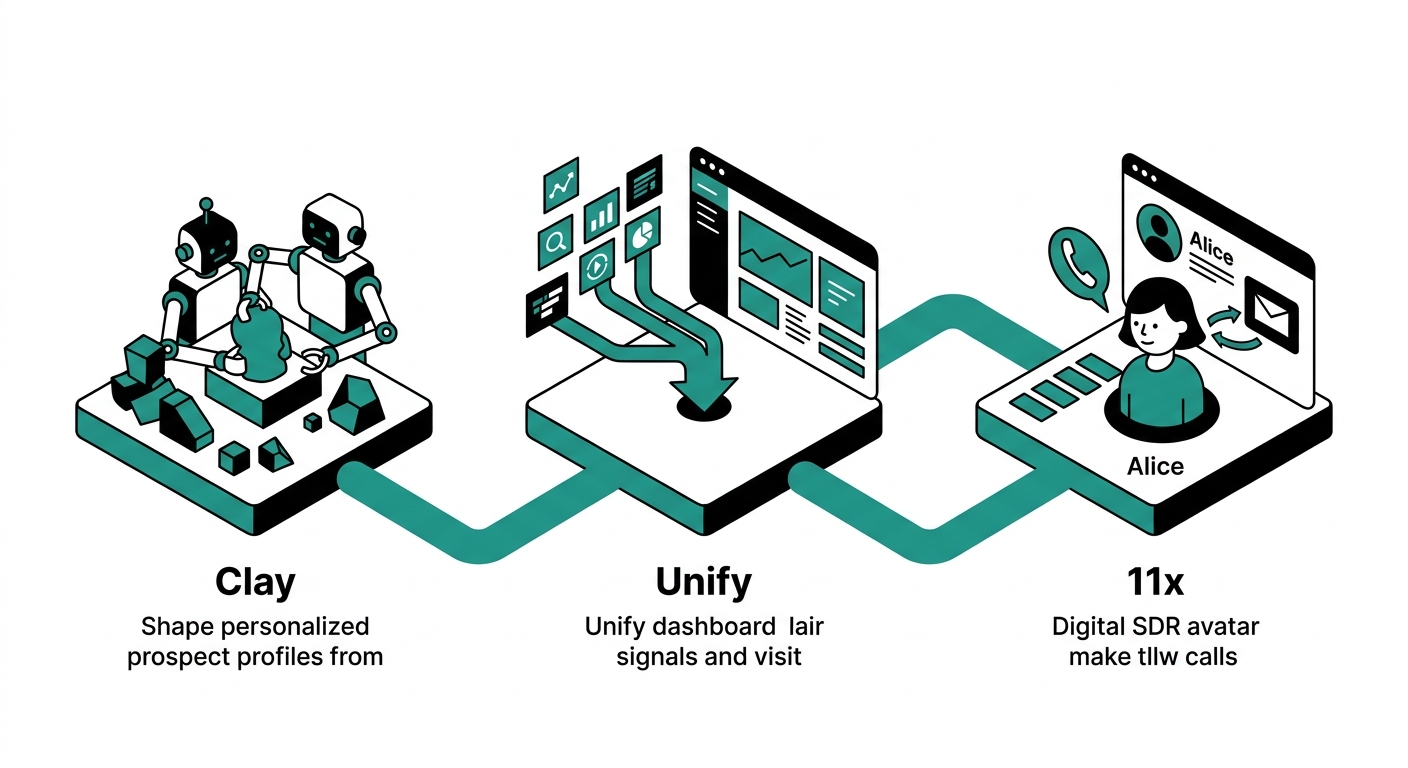
Picking an AI outbound tool in 2025 is harder than it looks. Vendors all promise the same thing: more pipeline, less manual work. But Clay, Unify, and 11x Alice are structurally different products that suit very different teams. Clay is an enrichment layer. Unify is an outbound engine. 11x Alice is an autonomous agent. Choosing the wrong one means wasted budget, not just wasted time.
This comparison breaks down how each tool works, what it actually costs, where it performs well, and where it falls short, so you can make a grounded decision for your sales org in 2026.
What Each Tool Actually Is
Before comparing features, it helps to understand what category each product belongs to. They sound similar in pitch decks, but under the hood they operate very differently.
Clay: Enrichment Workbench
Clay is a spreadsheet-style platform that connects to 150+ data providers and lets you build enrichment and research workflows. Think of it as Excel with live data APIs, AI research agents, and outreach integrations bolted on. Clay does not send outreach natively in most plans; it prepares data and routes it to tools like Smartlead, Instantly, or Outreach. The work is done by your team or a RevOps operator who builds and maintains the workflows.
Clay’s signature feature is waterfall enrichment: if Provider A cannot find an email address, Clay automatically queries Provider B, then C, until it gets a match. This approach reaches 80%+ email coverage for most B2B prospect lists, according to Persana AI. The trade-off is credit consumption, because each provider query costs credits.
Unify: Signal-Driven Outbound Engine
Unify is what happens when you combine a signal aggregation layer with a built-in sequencing tool. It monitors 25+ intent signal types, including website visitor identification, job changes, funding announcements, hiring patterns, and third-party sources like 6sense, Bombora, G2, and Clearbit. When a signal fires, a Unify “Play” automatically launches a personalized outreach sequence from the platform’s managed Gmail infrastructure.
Unify launched its Infinity Signal feature in March 2025, which uses OpenAI’s Computer-Using Agent and a GPT-5 Observation Model to support custom natural-language intent triggers. This moves the platform beyond fixed signal types and closer to account research on demand. Teams that adopted it early reported it takes 2-4 weeks to configure Plays and get the system fully operational.
11x Alice: Autonomous AI SDR Agent
11x positions Alice as a digital worker that replaces a human SDR seat. Alice handles prospect sourcing, profile research, email personalization, sequence execution, follow-ups, and meeting booking without a human in the loop at each step. The platform also offers Julian, an AI phone agent for inbound and outbound calling.
The pitch is straightforward: give Alice your ICP and she runs outbound autonomously, 24/7. The reality, based on customer reviews and the events of 2025, is more complicated.
Feature Comparison
| Feature | Clay | Unify | 11x Alice |
|---|---|---|---|
| Data providers | 150+ | 25+ intent sources | Internal research |
| Email finding | Waterfall enrichment | Native enrichment | AI-sourced |
| Built-in outreach | Explorer+ (via integrations) | Yes (managed Gmail) | Yes (email + LinkedIn) |
| Intent signals | Build your own | 25+ native signals | Static profile data |
| AI personalization | Claygent (AI research) | AI-generated copy on signals | Alice AI (adaptive tone) |
| CRM integrations | Pro plan+ | Salesforce, HubSpot only | Yes |
| Human oversight | High (you build it all) | Medium (Plays automate) | Low (mostly autonomous) |
| Deliverability tools | Via connected sequencers | Managed inbox infrastructure | None reported |
| Phone agent | No | No | Julian (add-on) |
| Free trial / self-serve | Yes (free plan) | No | No |
Pricing Breakdown
Clay Pricing
Clay uses a credit-based model. All plan prices are billed annually:
- Free: 100 credits/month
- Starter: from $134/month (2,000 credits/month)
- Explorer: from $314/month (10,000 credits/month), includes sequencer integrations
- Pro: from $549/month (up to 1.8M credits/year), includes CRM integrations
- Team: from $749/month
- Enterprise: custom pricing, unlimited rows, dedicated Slack support
The credit model looks straightforward on paper. In practice, building a profile that includes company data, contact email, phone number, and AI research can burn 15-25 credits per prospect. A team enriching 5,000 contacts per month on the Explorer plan will likely need to move up quickly, according to Warmly’s pricing breakdown.
Unify Pricing
Unify is priced for larger teams and requires annual commitment:
- Growth: $1,460/month (billed annually), 50,000 credits
- Pro: custom pricing, 200,000 credits
- Enterprise: custom pricing, 600,000 credits
Add-ons include $40/month per additional platform user, $100/month per email-sending user, and $20/month per additional mailbox. The total cost of ownership for a team of five SDRs can reach $2,500-3,000/month before credits run out, per Warmly’s analysis of Unify pricing.
11x Alice Pricing
11x does not publish pricing publicly. Based on reported contracts and G2 reviews, the starting price is $5,000/month with an annual contract required. The median reported contract is approximately $45,000/year, with some enterprise deals reaching $65,000/year, per AiSDR’s analysis. There is no free trial and no self-serve option.
Where Each Tool Performs Best
Clay: Maximum Control Over Enrichment Quality
Clay’s core advantage is breadth of data access. When you need to enrich a prospect list with verified emails, company technographics, recent funding announcements, job title history, and LinkedIn activity, Clay is the most capable single environment to run those queries. You are not locked into one provider’s data quality; you pick the best source for each field.
Claygent, the platform’s AI research agent, can scrape publicly available web data and summarize it in natural language, then feed that summary into a personalization formula for your sequence tool. This is powerful for account-based selling where hyper-specific context matters.
Clay is also the only platform of the three with a functional free plan, making it accessible for solo operators or early-stage teams who want to test the workflow before committing budget.
The limitation: Clay does not act for you. It prepares data. Someone on your team needs to build the tables, connect the providers, write the formulas, and route output to a sequencer. If you do not have a RevOps operator or a technically capable growth hire, Clay will sit underutilized.
Unify: Signal-to-Sequence Without the Build Work
Unify’s biggest practical advantage is that it removes the gap between a buying signal firing and an outreach sequence starting. With Clay, you must build a scheduled workflow, enrich on trigger, and push to a sequencer. With Unify, you define the audience and signal once, and the Play runs itself in near-real time.
The website visitor identification feature is particularly useful for teams with meaningful inbound traffic. When a target account visits the pricing page, Unify can fire an email within minutes, before the prospect moves on. That timing advantage is hard to replicate manually.
Unify also manages email infrastructure on your behalf, which reduces the operational overhead of inbox warming, domain rotation, and SPF/DKIM setup. For teams that have burned domains before, this is not a minor detail.
The downside: Unify supports Salesforce and HubSpot only. Teams running Pipedrive, Zoho, or other CRMs need to bridge through Zapier or a custom integration. And at $1,460/month as an entry point, it is priced for mature teams with existing pipeline to justify the spend.
11x Alice: Autonomous Outreach With Real Caveats
Alice’s appeal is clear: delegate cold outreach entirely to an AI agent and focus human sellers on inbound-qualified or warm opportunities. For the right team, particularly one that has proven its ICP and needs volume without headcount, that proposition makes sense.
Alice can handle email outreach and LinkedIn messaging simultaneously, which genuinely does something neither Clay nor Unify does natively. The dual-channel approach can improve reply rates for accounts that are less responsive on email alone.
However, the 2025 record on 11x raises real questions about product reliability. Specific credibility issues include:
- 11x raised $74 million in funding but reportedly experienced 70-80% customer churn, per Salesmotion’s reporting
- ZoomInfo stated publicly that 11x performed worse than their own SDRs before churning in February 2025, yet 11x continued listing ZoomInfo as a customer for months after
- CEO Hasan Sukkar departed in 2025 amid allegations of misrepresented customer counts and inflated ARR figures
- Alice has no native deliverability monitoring: no inbox placement testing, no domain health dashboard, and no SPF/DKIM/DMARC tracking. Sending at scale without these protections risks domain blacklisting
Users on G2 and Gartner Peer Insights report that Alice’s email copy often reads as generic despite detailed ICP input, with “zero results” reported by some users even after significant prompt engineering investment.
Head-to-Head: Clay vs Unify
These two products overlap the most in terms of the audience they attract, but they represent different working styles.
Clay rewards operators who think in spreadsheet logic and want to stitch together the best data source for every field. A skilled Clay user can build enrichment tables that outperform any single-vendor solution because they are mixing Apollo for emails, Clearbit for firmographics, and LinkedIn scraping for role verification all in one row. That flexibility has a ceiling: it takes time and technical skill to build, and it needs ongoing maintenance as APIs change.
Unify rewards teams that want a system already assembled. You configure the audience, pick your signals, write the sequence templates, and then Plays handle the rest. The tradeoff is that you accept Unify’s opinionated architecture. You cannot connect arbitrary data sources mid-workflow the way Clay permits.
Garrett Wolfe, a RevOps practitioner who wrote a detailed breakdown on Substack, summarized the difference well: Clay is for teams that want to do the work on their own terms; Unify is for teams that want the work done for them within a defined framework. Most experienced GTM operators who have used both end up on Clay for maximum flexibility, while earlier-stage teams get to production faster with Unify.
Head-to-Head: Unify vs 11x Alice
Both products pitch themselves as replacing manual SDR work, but they operate at different layers.
Unify automates the trigger and the sequence, but a human SDR is still expected to review, reply, and run the conversation once a prospect responds. Unify is a BDR tool, not a BDR replacement. Plays fire outreach, but the human rep handles replies and closes.
11x Alice is designed to handle the full outbound motion autonomously, including the initial reply conversation and meeting booking. In theory, a rep only sees a calendar invite. In practice, Alice’s reply-handling quality has been inconsistent, particularly for prospects asking non-standard questions or raising objections that require nuanced responses.
On pricing per seat of impact, Unify at $1,460/month is significantly cheaper than 11x at $5,000+/month for small teams. For large teams running high-volume outbound, the calculus shifts because 11x’s agent does not require per-seat SDR headcount.
Head-to-Head: Clay vs 11x Alice
These two products sit at opposite ends of the human-in-the-loop spectrum. Clay gives full control but requires human action at every stage. 11x Alice operates with minimal oversight by design.
Clay also wins on cost at the entry level by a wide margin. A startup can start enriching lists for $134/month on Clay. The equivalent budget does not get you past the discovery call with 11x’s sales team.
The more relevant comparison is for teams that have already proven their outbound motion. Once a team knows their ICP, messaging, and sequence structure, 11x Alice removes the operator overhead entirely. Clay still requires someone to keep workflows running. That operational cost is invisible in pricing tables but real in practice.
Which Tool Fits Your Team
Choose Clay if:
- You have a RevOps operator or technical growth hire who can build workflows
- You need to connect many different data sources in a single pipeline
- You run a small team or are early-stage and want to start affordably
- You want flexibility over which sequencer, CRM, and enrichment providers you use
- You are doing account-based research that requires custom per-account logic
Choose Unify if:
- You run a BDR team without a dedicated RevOps function
- You want buying signals to automatically trigger outreach without building workflows
- You have meaningful website traffic you want to capitalize on
- You use Salesforce or HubSpot and want native CRM sync
- Your budget supports the $1,460+/month entry point
Choose 11x Alice if:
- You want fully autonomous outbound with minimal day-to-day management
- You have verified your ICP and messaging and want to scale volume without headcount
- You can absorb the $5,000+/month cost and require annual contract flexibility
- You have done thorough due diligence on current product quality and company stability
- You pair Alice with a human team to handle complex replies and objections
Frequently Asked Questions
Is Clay actually an AI SDR tool?
No. Clay is a data enrichment platform, not an AI SDR. It pulls and cleans prospect data and can feed that data into sequencing tools, but it does not send outreach on its own in most configurations. Some users connect Clay to Smartlead or Instantly and describe the combined stack as an AI outbound system, but Clay itself is not an autonomous SDR agent. If you want built-in outreach sending, you need at minimum the Explorer plan plus a connected sequencer.
What happened to 11x.ai in 2025?
11x faced a credibility crisis in 2025. CEO Hasan Sukkar departed the company. Allegations emerged that 11x had misrepresented its customer list, including listing ZoomInfo as a customer for months after ZoomInfo churned due to poor results. Reports from Salesmotion and Pavilion estimated customer churn at 70-80%. The company had raised $74 million in funding prior to these events. Enterprise buyers evaluating 11x today should request verified customer references and current performance data before signing an annual contract.
Can you use Clay and Unify together?
Yes. Some teams use Clay for deep enrichment and list building, then import those enriched accounts into Unify to trigger signal-based outreach. Clay handles the research layer; Unify handles the outreach layer. This approach is more expensive because you are paying for both platforms, but it gives you Clay’s data depth combined with Unify’s real-time signal automation. It is most practical for teams with a RevOps function that can manage both systems.
Does Unify replace a human SDR?
Unify’s own positioning as of 2025 is as a BDR tool, not a BDR replacement. Plays fire outreach automatically when signals trigger, but human reps are expected to handle replies, run discovery calls, and progress the deal. Unify reduces the prospecting and sequencing time a BDR spends, but the conversation after a reply still requires a human. Teams that have tried to run Unify without any human reps have typically reintroduced human oversight within a quarter.
What is the minimum budget for 11x Alice?
Based on reported contracts, the floor is approximately $5,000/month with an annual commitment, which means a minimum annual spend of $60,000. Some contracts have been reported at $39,750-65,640 per year. 11x does not publish pricing and requires a sales call to get a quote. There is no free trial, no monthly billing option, and no self-serve signup.
How long does it take to get Clay working for outbound?
Getting Clay’s first table running typically takes a few hours. Getting a full enrichment-to-sequence workflow running reliably takes days to weeks, depending on how many providers you connect and how complex your targeting logic is. Teams without prior experience in Clay’s conditional formula system should budget for a learning curve. Many companies hire a Clay consultant or fractional RevOps operator to build the initial setup.
Is there a cheaper alternative to all three?
Yes. Tools like Apollo.io, Instantly, Smartlead, and AiSDR offer lower entry costs than any of the three platforms reviewed here. Apollo starts at $49/month and handles both prospecting and sequencing. AiSDR reports a 5.7% reply rate and operates at a significantly lower price point than 11x. Clay at $134/month is the most affordable of the three reviewed here and provides strong enrichment capability at that price.
Does 11x Alice work on LinkedIn as well as email?
Yes. Alice handles both email outreach and LinkedIn message automation as part of its multichannel approach. This is a genuine differentiator compared to Unify, which focuses primarily on email via its managed Gmail infrastructure, and Clay, which does not natively send outreach at all. However, LinkedIn automation carries platform risk: LinkedIn actively limits and bans accounts that use automation tools. Teams using Alice’s LinkedIn feature should check current LinkedIn policy compliance before scaling.
What CRMs does Unify support?
Unify natively integrates with Salesforce and HubSpot. No Pipedrive, Zoho, Close, or other CRM integrations are available as of 2025. Teams on other CRMs need to use Zapier or a manual export/import process to keep Unify data in sync with their system of record. This is a notable limitation for startups and mid-market companies that are not yet on Salesforce or HubSpot.
Can AI SDR tools actually book meetings without human help?
In limited use cases, yes. 11x Alice is designed to book meetings directly to a rep’s calendar without human involvement in the reply conversation. In practice, results are inconsistent. A 100,000-email analysis by Digital Applied found AI meeting-booked rates of 0.7% compared to 1.1% for human SDRs. AI reply rates were 4.1% versus 5.2% for humans. The gap is narrowing but humans still outperform autonomous AI agents in reply and booking rates as of 2025.
Bottom Line
Clay, Unify, and 11x Alice are all real products with real users getting real results. But they solve different problems at different price points for different teams.
Clay is the right choice for teams that want to own their data stack, have the operator talent to build it, and need flexibility above all else. At $134/month to start, it is also the lowest-risk entry point of the three.
Unify is the right choice for BDR teams that want signal-based outreach without building workflows from scratch, have the budget for the $1,460/month floor, and are already running on Salesforce or HubSpot.
11x Alice is the right choice for teams that want fully autonomous outbound and have done thorough due diligence on the platform’s current state. Given the events of 2025, that due diligence should be extensive before signing an annual contract at $5,000+/month.
The broader lesson from 2025 is that fully autonomous AI SDRs have not replaced human reps at scale. Companies that deployed 11x and similar tools as outright SDR replacements largely reverted to hybrid models within a year. The most successful teams are using enrichment and automation to make human SDRs faster and more targeted, not to remove humans from the outbound loop entirely.